
The Ultimate Guide to Investing in Vietnam Stock Market (2026 Edition)
Last updated: February 28, 2026 (Originally published: January 7, 2026)
The S&P 500 trades above 23x earnings. The Magnificent Seven dominate index returns. And if you’re a USD investor looking for genuine growth at a reasonable price, your options in developed markets are shrinking fast.
That’s exactly why I moved to Ho Chi Minh City a decade ago — and started putting real money into Vietnamese stocks.
This guide is everything I’ve learned from 10 years of investing directly in Vietnam’s stock market — from opening brokerage accounts and navigating foreign ownership limits, to surviving the 2022 crash and riding the recovery. I’ve watched foreign investors build serious wealth here. I’ve also watched them blow up accounts on rookie mistakes that a local broker could have warned them about over a cup of trà đá (iced tea).
This is not a hype piece. Vietnam has real risks: currency volatility, corporate governance issues, and a regulatory environment that still surprises veterans. But it also offers something increasingly rare in global markets — genuine growth at a discount.
Let’s dig in.
Why Vietnam? The Investment Case for the Next Decade
The Valuation Gap
Let’s start with the numbers that matter.
| Metric | Vietnam (VN-Index) | USA (S&P 500) |
| P/E Ratio | 13x – 14x | 23x – 25x |
| Dividend Yield | 3% – 4% (up to 10%) | ~1.5% |
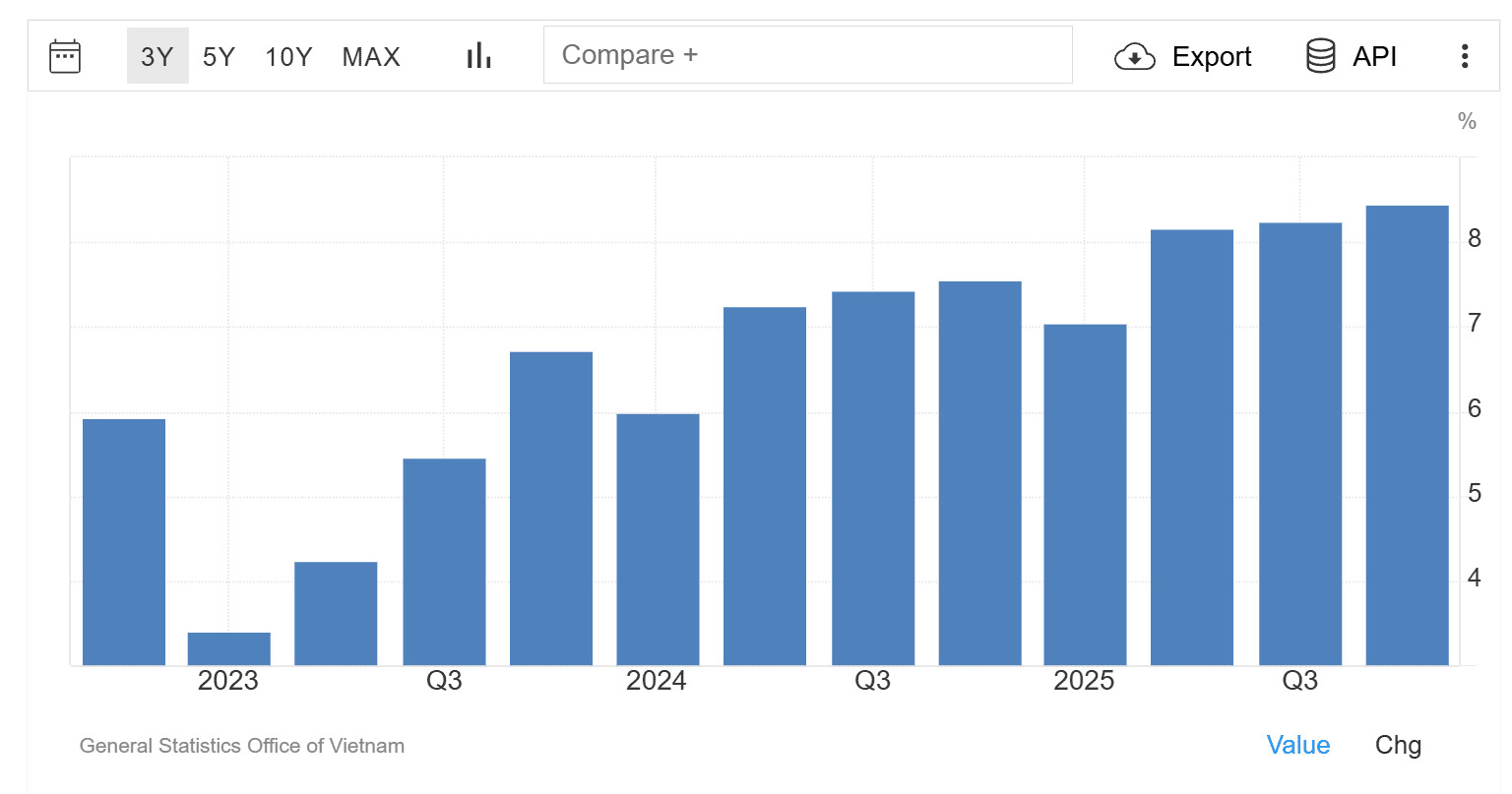
| GDP Growth (2025 Target) | 6.5% – 7% | ~2% |
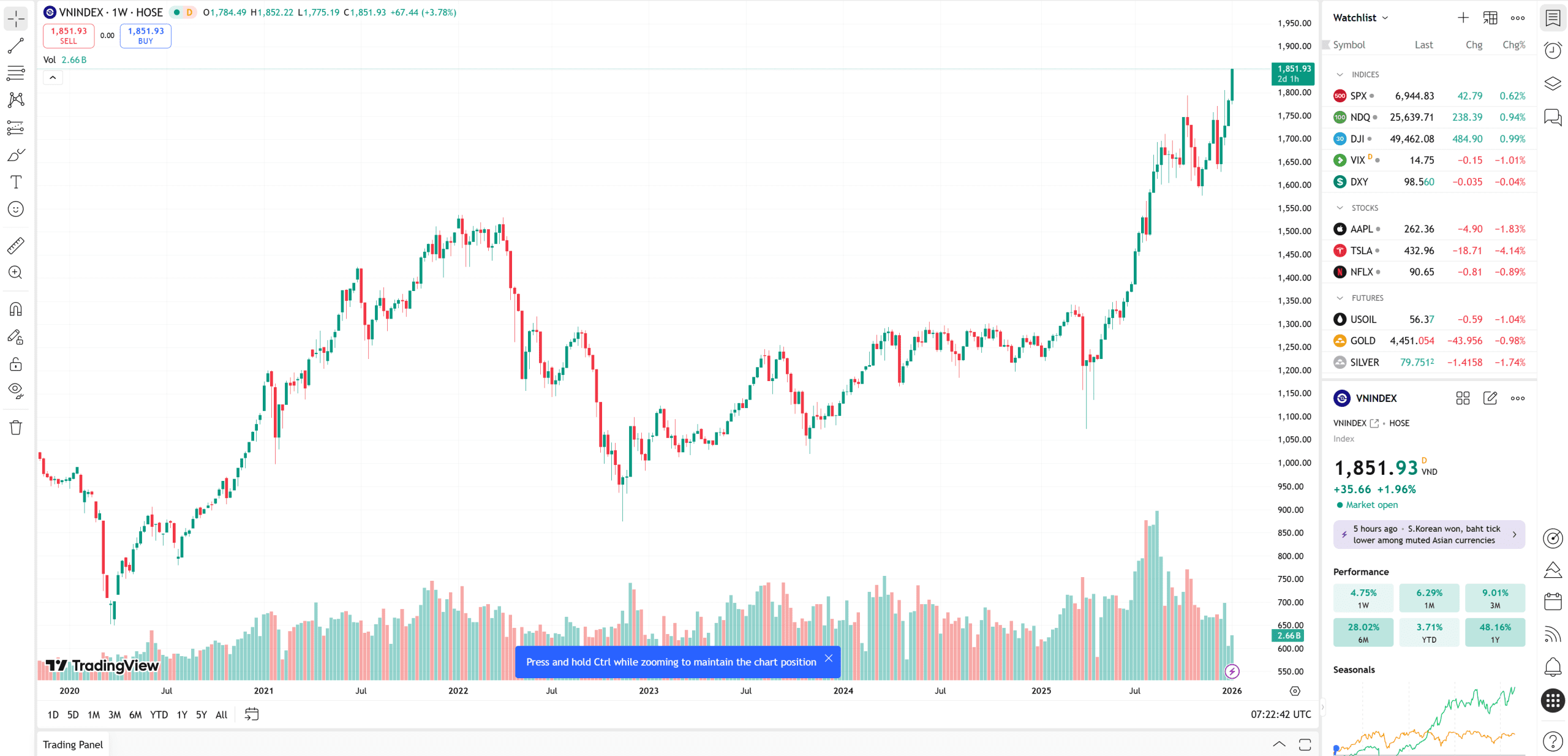
Vietnam trades at nearly half the valuation of the US market while growing three times faster. This isn’t a “deep value” trap in a shrinking economy. It’s a discount on expansion. For a deeper breakdown of what USD investors can realistically expect, read my analysis on what returns are realistic for foreign investors.
The “China +1” Tailwind
After COVID exposed global supply chain vulnerabilities, multinational corporations adopted a simple strategy: don’t put all your factories in China. Vietnam became the primary beneficiary.
The FDI roster reads like a Fortune 500 directory:
- Samsung manufactures over 50% of its smartphones here
- Apple suppliers (Foxconn, Luxshare) have expanded aggressively
- Intel operates a major chip assembly and test facility
- Lego is building its first carbon-neutral factory in the country
This isn’t speculative. These are factories already running, workers already employed, exports already shipping. The “China +1” story is no longer a thesis — it’s an earnings driver. This manufacturing boom is one of the key reasons Vietnam’s GDP growth continues to outpace the region.
The Demographics Most Investors Miss
Vietnam has 100 million people. The median age is 31. For context, China’s median age is 39 and climbing fast.
What does this mean for investors?
- A growing labor force that keeps manufacturing competitive
- A rising middle class driving domestic consumption
- Increasing smartphone and internet penetration fueling fintech and e-commerce
This is not Indonesia (archipelago logistics nightmare) or India (bureaucratic maze). Vietnam offers a concentrated, coastal population with improving infrastructure and a government laser-focused on economic growth.
The Risks You Must Acknowledge
Vietnam is an emerging market. That label exists for a reason.
- Currency risk: The Vietnamese Dong (VND) can depreciate against the USD during global risk-off events
- Liquidity: Daily trading volume is a fraction of US markets; large positions are harder to exit
- Corporate governance: Disclosure standards are improving but not yet at developed-market levels
- Regulatory surprises: Rules can change with limited notice
The opportunity is real. So are the risks. This guide will help you navigate both. For a detailed risk breakdown, I wrote a separate deep-dive on whether investing in Vietnam is safe.
Understanding the Landscape — Vietnam’s Three Stock Exchanges
If you’re coming from US markets, think of Vietnam’s exchange structure as a tiered system — similar to how you’d differentiate between the NYSE, NASDAQ, and OTC Markets. For a complete breakdown of how the VN-Index works and how it’s calculated, I’ve written a dedicated explainer.
HOSE — The Main Stage
Ho Chi Minh Stock Exchange (HOSE) is where the big players trade. This is Vietnam’s NYSE.
- What’s listed: Large-cap companies, blue chips, the VN30 Index constituents
- Daily price limit: ±7% (stocks can only move 7% up or down in a single session)
- Liquidity: Highest in the country
- Examples: Vingroup (VIC), FPT Corporation (FPT), Vietcombank (VCB)
If you’re building a core Vietnam portfolio, you’ll spend most of your time here. Check out our list of the Top 10 Vietnam Blue Chips to identify the strongest names on HOSE.
HNX — The Mid-Cap Arena
Hanoi Stock Exchange (HNX) hosts mid-cap and small-cap companies. Think of it as Vietnam’s NASDAQ — minus the tech concentration.
- What’s listed: Smaller companies, some state-owned enterprises, government bonds
- Daily price limit: ±10%
- Liquidity: Moderate; spreads can widen on less popular names
HNX offers more volatility and occasionally more opportunity. But due diligence matters more here — analyst coverage is thinner.
UPCoM — The Wild West
Unlisted Public Company Market (UPCoM) is where things get interesting — and risky.
- What’s listed: Companies not yet qualified for HOSE or HNX, pre-IPO firms, delisted stocks
- Daily price limit: ±15%
- Liquidity: Often very thin
- Risk level: High. This is Vietnam’s equivalent of US penny stocks or OTC Markets.
Some hidden gems exist on UPCoM. So do landmines. Unless you have strong local research or deep sector expertise, approach with caution.
Quick Reference: Exchange Comparison
| Exchange | Market Cap | Price Band | Liquidity | US Equivalent |
| HOSE | Large-cap | ±7% | High | NYSE |
| HNX | Mid/Small-cap | ±10% | Moderate | NASDAQ (small-cap) |
| UPCoM | Pre-listing/OTC | ±15% | Low | OTC Markets |
The Rules of the Game — Trading Mechanics for Foreign Investors
Vietnam’s market operates differently from what you’re used to. Before you place your first order, understand these mechanics. I cover the full details — including session types, order matching, and holiday calendar — in my guide to Vietnam stock market hours and trading rules.
Settlement Cycle: T+2.5
In the US, you’re used to T+1 settlement. Vietnam runs on T+2.5.
Here’s what that means in practice:
- Monday morning: You buy 1,000 shares of VCB
- Wednesday afternoon: Those shares settle in your account and become sellable
You cannot sell shares the same day or next day. This matters if you’re used to swing trading or need quick exits. Plan your entries knowing your capital will be locked for 2.5 trading days.
Lot Size: 100 Shares Minimum
Every order must be in multiples of 100 shares (this is called a “lot” or “board lot”).
- Want to buy 150 shares? You can’t. It’s either 100 or 200.
- This affects position sizing, especially in high-priced stocks
Some brokers offer “odd lot” trading for quantities under 100, but liquidity is poor and execution is not guaranteed.
Daily Price Limits (Circuit Breakers)
Unlike US markets where stocks can theoretically move 50% in a day, Vietnam caps daily movement:
- HOSE: ±7%
- HNX: ±10%
- UPCoM: ±15%
This protects against flash crashes but also means you might get stuck in a “ceiling” or “floor” situation — where a stock hits its daily limit and no one can trade at a better price until the next session.
Trading Hours (Local Time: GMT+7)
| Session | Time |
| Morning | 9:00 AM – 11:30 AM |
| Afternoon | 1:00 PM – 2:45 PM |
| ATC (Closing Auction) | 2:45 PM – 3:00 PM |
ATC (At-The-Close) is a single-price auction that determines the closing price. Many institutional investors place large orders here to minimize market impact.
The Foreign Ownership Limit (FOL) Problem
This is the #1 frustration for foreign investors in Vietnam. Let me explain why you might not be able to buy the stocks you want. I’ve written a complete FOL guide covering every workaround, but here’s the summary.
What Is FOL?
Vietnamese regulators cap how much of a company foreigners can collectively own. For most sectors, this limit is 49%. For “sensitive” sectors (banking, media, logistics), it can be 30% or lower.
The “Full Room” Problem
When foreign investors collectively hit that ownership ceiling, the stock is declared “full room” or “hết room” in Vietnamese.
Once a stock is full room:
- You cannot buy it on the open market (no foreign buying allowed)
- You can only acquire shares from another foreigner willing to sell
- These off-exchange transactions often carry a premium of 10-20% above market price
Which Stocks Are Full Room?
Many of Vietnam’s best companies — the ones you actually want to own — are permanently full:
- FPT Corporation (FPT) — Vietnam’s largest tech company
- Mobile World Group (MWG) — dominant electronics and grocery retailer
- Refrigeration Electrical Engineering (REE) — diversified industrial leader
These are called “Diamond Stocks” locally because they’re high-quality but nearly impossible for foreigners to access directly.
💡 PRO TIP: The Diamond ETF Workaround
Can’t buy FPT or MWG directly? There’s a legal solution.
DCVFM VNDiamond ETF (Ticker: FUEVFVND) is a locally-listed ETF that holds a basket of these full-room “Diamond” stocks. Because it’s structured as a Vietnamese fund, it faces no FOL restrictions.
What you get:
- Exposure to premium stocks otherwise blocked to foreigners
- Diversified basket (not single-stock risk)
- Trades on HOSE like any other stock
What to watch:
- ETF may trade at a slight premium to NAV due to demand
- Management fees apply (check the fund prospectus)
For many foreign investors, FUEVFVND is the simplest way to access Vietnam’s highest-quality names without paying a 15% off-market premium. I compare this and other options in my Vietnam ETF comparison guide.
Taxes for Foreign Investors — One Bright Spot
After all those warnings, here’s something that works in your favor.
| Tax Type | Vietnam | United States |
| Capital Gains Tax | 0.1% of sale value | 15-37% on profits |
| Dividend Tax | 5% | 0-20% (qualified) |
| Filing Required | No | Yes (annual) |
Let that sink in.
In the US, short-term capital gains can hit 37% for high earners. In Vietnam, you pay 0.1% whether you held for one week or ten years. Whether you made a profit or took a loss.
The math on a winning trade:
- Buy VND 500 million, sell at VND 600 million (20% gain)
- Vietnam tax: VND 600,000 (0.1% of sale) = ~$24 USD
- US equivalent on same gain: $4,000+ depending on bracket
This isn’t tax advice — consult your accountant on US reporting obligations for foreign investments. But the Vietnamese side is as friendly as it gets.
Ready to start? Here is the step-by-step guide on how to open a Vietnam brokerage account as a foreigner.
Risks You Must Know — An Honest Assessment
I’ve spent a decade in this market. I’ve made money here. I’ve also watched foreign investors blow up accounts because they treated Vietnam like a casino or ignored risks that locals discuss openly over trà đá.
Let me be direct about what can go wrong.
Currency Risk: The Silent Portfolio Killer
You’re investing in Vietnamese Dong (VND). Your returns are measured in USD. This mismatch matters.
The State Bank of Vietnam manages the VND within a controlled band against the USD. In stable years, depreciation runs 2-3% annually — manageable, often offset by dividends. But during global risk-off events (2008, 2015, 2022), the Dong can slide 5-7% in months.
What this means for you:
- A stock that gains 15% in VND but coincides with 7% currency depreciation delivers only ~8% in USD terms
- Dividend income gets eroded by the same mechanism
- You have no hedge readily available (VND futures don’t exist for retail investors)
Currency risk doesn’t make Vietnam uninvestable. It makes Vietnam a market where you need to think in total USD returns, not just stock price gains.
Emerging Market Volatility: Buckle Up
The VN-Index is not the S&P 500. It moves differently.
- 2018: Index dropped 25% in six months on trade war fears
- 2022: A banking scandal triggered a 35% drawdown peak-to-trough
- Recovery: Both times, the market recovered within 18-24 months
Volatility cuts both ways. The 2024 rally delivered 15%+ returns. But if you panic-sold in late 2022, you locked in losses right before the rebound.
The pattern I’ve observed: Foreign retail investors often buy after a rally (FOMO) and sell during corrections (fear). Local institutions do the opposite. Don’t be the liquidity that smart money exploits.
Liquidity Risk: Getting In Is Easy, Getting Out Is Harder
Vietnam’s total market cap is roughly $200 billion — smaller than Apple alone.
For small positions ($10,000-$50,000), this doesn’t matter. But if you’re deploying serious capital:
- Large orders move prices against you
- Exiting a position can take days or weeks in mid-cap names
- During market panics, bid-ask spreads blow out
Practical advice: Stick to VN30 stocks and major ETFs unless you have a long time horizon and strong conviction on smaller names.
Corporate Governance: Improving, But Not There Yet
Vietnamese disclosure standards have come a long way since 2010. But gaps remain.
- Related-party transactions are common and not always clearly reported
- Some controlling shareholders treat listed companies as personal ATMs
- Auditor quality varies significantly
The 2022 Van Thinh Phat scandal — where a real estate tycoon allegedly embezzled billions through a bank — was a reminder that fraud risk is real.
My approach: I stick to companies with reputable Big 4 auditors, clear ownership structures, and management teams with skin in the game. The extra due diligence is worth it.
Regulatory Whiplash
Vietnam’s government is pro-business, but regulatory changes can come fast and without warning.
Recent examples:
- 2023: Sudden tightening of corporate bond issuance rules (crushed real estate developers)
- 2024: New regulations on foreign ownership in certain sectors
- Ongoing: Shifting rules around pre-funding requirements for foreign investors
The market typically overreacts to regulatory news, then normalizes. But if you’re concentrated in a sector that gets targeted, the drawdown is real.
The FTSE Upgrade Catalyst — Why 2026 Matters
If you’re reading this guide in 2026, your timing may be better than you think. Vietnam is on track for a potential FTSE Russell upgrade from frontier to emerging market status, expected to be reviewed in September 2026.
Why does this matter? When FTSE reclassifies a country, billions of dollars in passive fund flows follow automatically. Index-tracking funds that benchmark to FTSE Emerging Markets would be required to add Vietnam exposure. Estimates range from $1-3 billion in new institutional capital.
This isn’t speculation — it’s how index mechanics work. But a word of caution: markets often “price in” upgrades before they happen. The smart play is positioning early and understanding which stocks benefit most, not chasing after the announcement.
How to Get Started — Your Next Steps
If you’ve made it this far, you’re more informed than 90% of foreign investors who look at Vietnam. Here’s how to turn knowledge into action.
Step 1: Decide your entry method. You can invest directly through a Vietnamese brokerage account (more control, lower fees) or indirectly through a Vietnam-focused ETF like VNM from your existing US brokerage (simpler, but higher expense ratios and less precise exposure).
Step 2: Start small. Allocate 3-5% of your portfolio to Vietnam. This gives you meaningful exposure without concentration risk. You can always scale up as you build conviction.
Step 3: Learn the specific mechanics. Read my complete start-here guide for a step-by-step roadmap tailored to US investors.
Vietnam Is a Marathon, Not a Sprint
Let me leave you with the perspective I share with every foreign investor I meet in Ho Chi Minh City.
Vietnam is not a get-rich-quick market.
It’s a long-term allocation for patient capital. The thesis is structural: a young, growing population; a manufacturing base absorbing global supply chain shifts; a valuation discount to developed markets; and a government that has prioritized economic growth for three decades straight.
The risks are real. Currency moves will test your conviction. Volatility will shake out weak hands. Corporate governance will occasionally disappoint you. And the trading mechanics — T+2.5 settlement, foreign ownership limits, daily price bands — require adjustment if you’re used to US markets.
But here’s what I’ve learned after a decade of investing here:
The investors who do well in Vietnam share three traits:
- They size positions appropriately — Vietnam is a satellite allocation, not a core holding
- They think in 3-5 year horizons — not quarters, not months
- They keep learning — the market evolves, and so should your knowledge
At 13x earnings with 6.5% GDP growth, Vietnam offers something rare in today’s world: growth at a reasonable price. The opportunity is real. So is the complexity. This guide is your starting point — the rest is up to you.
Frequently Asked Questions
How does the Vietnam stock market work?
Vietnam’s stock market operates through three exchanges: HOSE (large-cap, ±7% daily price limit), HNX (mid/small-cap, ±10%), and UPCoM (pre-listing, ±15%). Trading runs from 9:00 AM to 3:00 PM (GMT+7), Monday through Friday. Settlement takes T+2.5 days, and all orders must be placed in 100-share lots. Foreign investors need a local brokerage account and a securities trading code to participate.
What are the trading hours for the Vietnam stock exchange?
The Vietnam stock exchange (HOSE) trades in two sessions: the morning session from 9:00 AM to 11:30 AM and the afternoon session from 1:00 PM to 2:45 PM, both in GMT+7 (Vietnam local time). There’s also an ATC (At-The-Close) auction from 2:45 PM to 3:00 PM that determines the closing price. For US-based investors, that’s roughly 9:00 PM to 3:00 AM Eastern Time.
What is the difference between HOSE and HNX?
HOSE (Ho Chi Minh Stock Exchange) lists Vietnam’s largest companies like Vingroup, FPT, and Vietcombank — it’s the equivalent of the NYSE. HNX (Hanoi Stock Exchange) lists smaller mid-cap companies and state-owned enterprises, similar to a small-cap NASDAQ. HOSE has a tighter ±7% daily price limit and higher liquidity, while HNX allows ±10% daily moves but with thinner trading volumes.
How many stocks are listed on the Vietnamese stock market?
As of 2026, there are approximately 400+ companies listed on HOSE, 300+ on HNX, and 800+ on UPCoM, totaling over 1,500 publicly traded companies. However, most foreign investor activity concentrates on the VN30 Index — the 30 largest and most liquid stocks on HOSE — which accounts for roughly 70-80% of total market trading volume.
Keep Reading
Ready to go deeper? Here’s where to head next based on where you are in your Vietnam investing journey:
- Just getting started? Read the Complete Start-Here Guide for Vietnam Investors
- Want to pick stocks? See the Vietnam “Magnificent 10” Blue Chips
- Prefer ETFs? Compare your options in my VNM ETF Review
- Ready to open an account? Follow my guide to the Best Vietnam Brokers for Foreigners